


Traction-style bass fishing has become, with the advent of soft lures, a technique favored by many anglers. However, putting it into practice requires specific animations based on amplitude, speed, reactivity, and also on the ability to feel the bottom and the bites. To be effective, it’s therefore essential to choose a blank whose length, power, and action are well suited.

What is traction-style fishing?
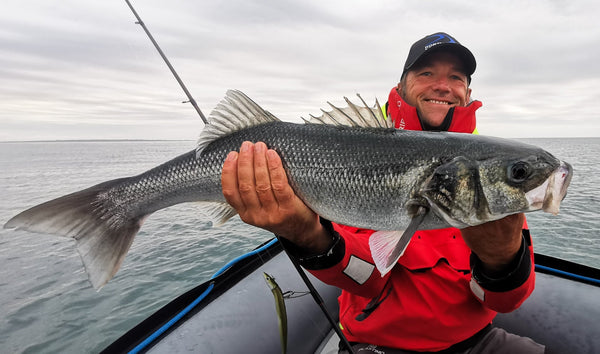
Originally invented for European seabass, traction-style fishing is also highly effective in freshwater, especially for pike. It’s practiced mostly with soft shad-type lures, but it also works very well with tail-less, slender models reminiscent of sandeels.
It consists of alternating long, sweeping pulls with slack-drop phases, either near the bottom or in mid-water. The first phase, generally punchy, is meant to spark the curiosity of predators holding in the area; the second offers an easy attack window. Strikes therefore occur 99 % of the time during this second phase of the animation.
Although this technique is often done from a boat because it needs a minimum depth, it can still be performed from the bank on steep shores that give direct access to deep water. Usable with different lure sizes and, above all, a range of weights (even 7 g), it lets you explore zones from 3 to 30 m deep. The most suitable spots are large, current-swept rock plateaus, isolated rock heads, or pronounced drop-offs.

Tackle requirements for traction-style fishing
— Because traction relies on broad movements, a relatively long blank is a must. Rods between 2.40 m and 2.60 m are ideal.
— To control the lure’s running depth precisely, detect every bite, and read bottom contact, resonance and sensitivity—the ability to “feel” your lure—are critical. Choosing a high-modulus carbon blank is therefore essential.
— Finally, to maximize feedback, achieve decisive hook-sets, and steer the lure precisely, a fast action is also indispensable. A firm tip is often the best match, but a slightly “livelier” tip will offer more versatility with lighter weights and better line control.
— The blank’s power should be determined by the nature of the spots and the lures used. Clearly, 12 cm shads on 21 g heads don’t call for the same tool as 18 cm lures rigged on 45 g heads. You’ll therefore find many models—from 10–30 g to 30–90 g—covering the full range of contexts.

The indispensable 800 series
To build a rod dedicated specifically to traction-style fishing, there’s no need to hesitate: choose North Fork Composites’ 800 series, whose characteristics meet the requirements described above point for point.
The 805HM lets you fish lures from 10 to 30 g and is also an excellent choice for shore anglers.
The 807HM is North Fork Composites’ bestseller for this technique thanks to its mid-range power that covers the vast majority of situations. Rated 15–50 g, it works equally well with 12 cm shads at 21 g and 15 cm models at 42 g.
The 809HM, for its part, with a 30–80 g rating, is ideal for the heaviest applications.
At NFC, the SJ 804 Delta also shines for traction-style fishing, with a rounder action that delights many practitioners.
At Rodbuilder’s Republic, the PPS 80H and 80XH have likewise become must-have references: they cover essentially the same power range as the 807 and 809.
Finally, for fans of shorter models, Rodbuilder’s Republic’s Statement 766 and Phenix’s PHX 764 allow you to work, respectively, 10–40 g lures for the former and 15–50 g for the latter.


Comments
0Log in to leave a comment.
Log in