


How to build a rod optimised for euro nymphing
Euro nymphing is one of the must-have techniques for success on rivers when targeting trout and grayling, but also barbel, dace and many other fish that should not be underestimated. The principle is simple: you present one or two weighted nymphs in as natural a drift as possible to fish that are feeding well below the surface. The fly line is taken out of the equation (hence the name of the technique), and casting is done using the weight of the nymphs, just as you would with very small lures.
Once the nymphs have been sent into the right current seam, the whole art of this style of fishing is to manage the line while maintaining a minimal, but not completely slack, tension so that our imitations can follow the current at the correct depth without dragging. Sometimes the take shows as a very clear tap in the hand, but more often it is much more subtle: a slight change in the movement of the line, a brief pause… and that is the moment to strike.
As you can see, the way a euro nymphing setup fishes is very different from dry-fly work. This difference creates specific demands that a properly built euro nymphing rod must help you deal with as effectively as possible. That is the purpose of this article: to offer a set of build guidelines, used on the water and in competition by our Prostaff team, to turn your rod into a sharp, specialised tool. First, we will go through the concepts that guide our building choices. Then we will look more concretely at how to apply them, using a Rodbuilders’ Republic Lighthouse LH 1102-4 build as our example.
The specific demands of the technique
Before getting into rodbuilding, it is useful to clarify the brief: what are the key points to keep in mind when you are building a rod dedicated to euro nymphing?
Enhancing the rod’s resonance
Euro nymphing is probably the most tactile form of fly fishing. Experts do rely heavily on the behaviour of the line in the current to detect takes, but having information that travels up the line through the rod into the hand is still a sometimes decisive advantage. Beyond the takes themselves, it is extremely valuable to feel how the nymph behaves and when it touches the bottom.
Ideally, a rod behaves like an amplifier: the ideal rod is therefore as resonant as possible. You achieve this kind of performance by working on two aspects of the build.
The lightness of the tip. Mass is the main insulator when it comes to transmitting vibrations. The more weight there is in the upper part of the rod, the less responsive it will be. To guarantee maximum lightness in the upper half, the single most important factor is the choice of a well-designed blank. The overall weight of the blank is one indication you can use to anticipate how resonant the tip will be. The type of carbon also plays a role, as do the skills of the design team. Then you must make sure not to add unnecessary weight to the tip, particularly through the guides.
The design of the grip. You should favour materials that transmit vibrations well and/or shapes that encourage a grip allowing direct contact with the blank. The grip is an essential link in the information chain between the line and the angler’s hand.
Limiting line belly
Fishing with a long rod and a very fine, only lightly weighted leader means being exposed to the effects of the wind. As soon as a belly forms between two guides, sensitivity and control collapse: you end up fishing only approximately, if not downright poorly. The rod therefore needs to be built in such a way that this phenomenon is limited: the line must be guided by guides whose spacing is never excessively wide.
Preventing the line from sticking to the blank
Another difficulty under the same conditions (fine line, light weighting) is the tendency of the line to stick to the blank when it is wet, which often happens when you are using it in mid-river. This phenomenon is well known to match anglers, who have adopted very high-frame guides that lift the line away from the blank and prevent it from sticking. The blank’s finish can also help to limit this problem: this is particularly the case on the euro nymphing blanks from Rodbuilders' Republic.
Balancing a long rod
The posture used in euro nymphing can be demanding: most of the time you hold the long rod at arm’s length, looking for extra reach to optimise drift control. To reduce fatigue, it is important to aim both for low overall weight of the rod + reel outfit and for good balance of that outfit, in order to avoid those horrible combinations that are “tip-heavy” and end up wearing out your wrist.
Let us now see how these principles translate into concrete rodbuilding decisions. As an illustration, we will describe the build of a rod which, in our view, is technically optimised for euro nymphing.
Building a LH 1102 Rodbuilders’ Republic
The blank
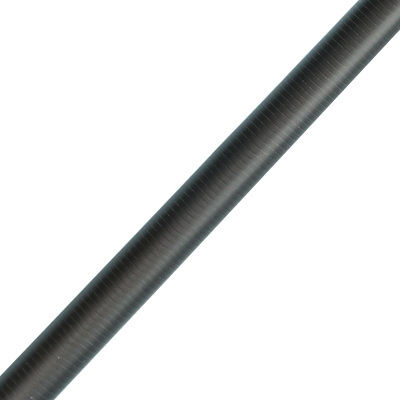
The Rodbuilders' Republic Lighthouse 1102-4 is an example of a blank whose design has been thought through from end to end for euro nymphing. Its length of 11' (3.32 m) matches the current standard among top-level competitors. Its weight (45 g) is remarkably low for this length. Its objective power (IP = 72 g) makes it a true #2 line-class blank, a fine, delicate tool perfectly suited to fishing nymphs tied on 2 to 3.5 mm beads. The ribbed “raw tape” finish limits line adhesion when the atmosphere is humid.

The guides
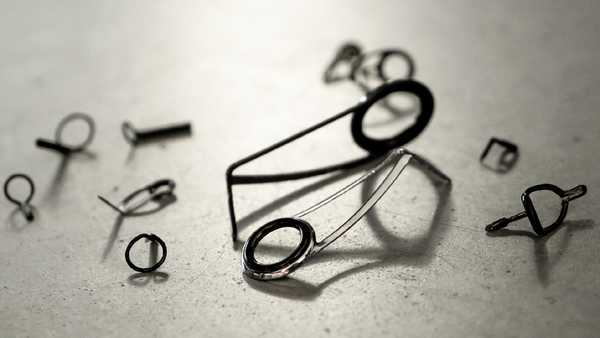
The fundamental principle here is the pursuit of maximum lightness. As a general rule, it is considered that you need 10 guides on a 9-foot rod, and that you fit n+1 guides on an n-foot rod. For euro nymphing, that is not enough: to limit line belly, you need to reduce the gaps between the guides. But more guides also mean more weight on the rod, and therefore less resonance and less liveliness in the hand. A good compromise is around 13 guides, although you sometimes see very good builds with 14.
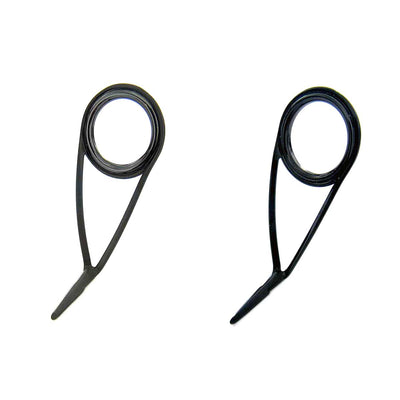
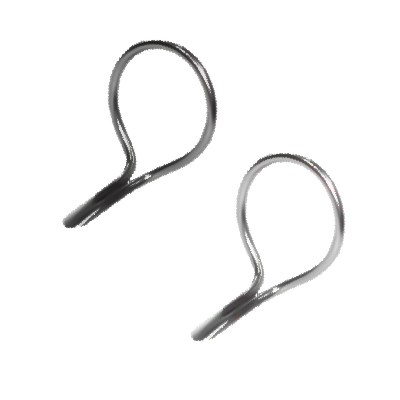
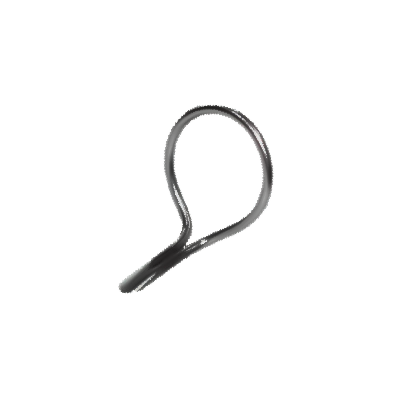
You will choose a guide model that is as light as possible. In this regard, Recoil RSF guides are hard to beat. They are single-foot guides, and this is important: it halves the number of wrapped and varnished feet, which makes a noticeable difference on the tip of a fine 11' blank. You start the guide train with a ceramic insert stripper in the shape of your choice, but in size 12. From the standpoint of maximum lightness, a Fuji KL in Titanium Torzite Polished Dark Grey is ideal: very light, discreet and, in a word, efficient.

You then carry out a quick reduction with a Recoil RSF #6, followed by a #4 and a #2, and finally nine RSF #1 running guides. The whole set will be black: if you can avoid stray reflections, you might as well do so.
Once the guides have been chosen, the question is where to place them. Here are the spacings between the guides, in millimetres, measured from the tip-top: 110 – 120 – 135 – 150 – 165 – 180 – 195 – 220 – 245 – 280 – 300 – 330 – 335.
With a grip fitted with a fighting butt, this layout places the stripper roughly thirty centimetres in front of the cork, which is ideal for preventing line belly.
The grip
As the point of contact between the angler and the rod, the grip plays a major role. This is true for all types of fishing, but even more so for such a tactile technique as euro nymphing.
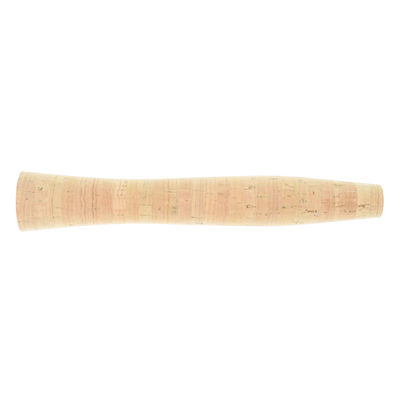
First choice: material. Two main schools of thought coexist. Many anglers, including some of the best in the world, remain attached to cork. It is the traditional material: very light and, in good quality, remarkably comfortable in the hand. Rodbuilders' Republic offers a half wells (tulip-shaped) grip specifically designed for euro nymphing, short enough to make it easy for the index finger to touch the blank, and slim enough not to smother sensitivity. This point is crucial, because despite its qualities, cork has one drawback for euro nymphing: it is an insulator and transmits vibrations poorly.
Second option: a carbon grip. The carbon shell of these grips sits on a rigid polyurethane core; the whole assembly works like a sound box. It is hard to get more sensitive than that. The very slim half wells shape works perfectly with an index-on-top grip. The main drawback of carbon is the feel: depending on the model it is either textured (Rodbuilders' Republic half wells) or smooth (NFC Soft Touch), but always hard. Some anglers love it, others tolerate it for the sake of resonance, and others still have trouble getting used to it. It all comes down to personal preference.
As for the reel seat model, all options are open; the choice is primarily an aesthetic one (with a small mounting nuance that we will discuss in the following section).
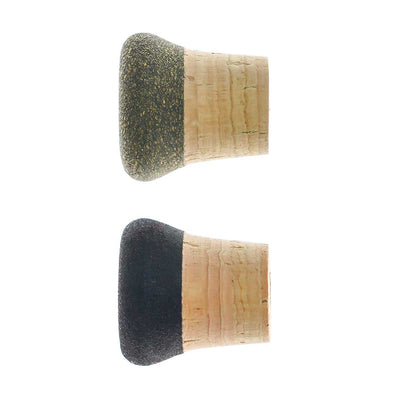
Then there is the question of the fighting butt. You can do without it and save a few grams as well as a few centimetres of reach. You can also decide that those grams are a worthwhile investment: the butt gives the forearm a very useful point of support, both when fishing and when playing a good fish. It is also a good way of protecting the sometimes delicate mechanics of certain reels from hitting the ground.
The balance of the rod + reel setup
As mentioned above, the question of balance has two sides: what is the total weight of the ready-to-fish setup, and where is its centre of gravity located? As often in rodbuilding, several schools of thought coexist and everyone finds their own way – this is what makes custom building so interesting.
Some anglers prioritise the lowest possible overall weight of rod and reel and choose all the components with one eye on the scales. The idea is that when you fish for long hours with your arm extended, you need to protect your shoulder, which means reducing the total weight as much as possible. A very light reel, such as a Vivarelli, will generally not be enough to balance the weight of the blank; the setup will be somewhat tip-heavy (centre of gravity in front of the grip), but these anglers accept this in exchange for an incomparably light outfit.
For others, the main concern is to spare the wrist: they prefer to fish with a rod whose centre of gravity lies under the index finger, so that the rod naturally sits horizontally (or even slightly nose-up) when held in the hand. To achieve this balance, there are two effective measures that can be combined.
The first is obviously to choose a slightly heavier reel. The second, more elegant option, because it keeps the overall weight relatively low, is to mount the reel seat in a reversed configuration, known as down-locking. This places the reel further away from the hand, improving balance at constant mass. Rodbuilders' Republic even offers a beautiful carbon reel seat designed specifically for this down-locking setup, which looks superb paired with a euro nymphing cork grip.
Finally, prevention is better than cure: before you start compensating for the weight of the tip, it is always worth trying to keep it down. In addition to the choice of ultra-light Recoil RSF guides already mentioned, you should aim to keep your wraps as short as possible, use size A thread and apply only a thin coat of finish. These are small details, but rodbuilding is precisely about pushing performance at the finest possible level.
Two grip profiles for euro nymphing
We suggest two grip profiles, each illustrating one of the schools of thought described above.
The first profile embodies a kind of technical uncompromising approach: a carbon grip from Rodbuilders' Republic for maximum resonance, an RR-FRSDL down-locking reel seat for perfect balance and a consistent carbon-on-carbon theme, plus a minimalist fighting butt in rubber cork (RRBC29), extremely robust – a setup resolutely geared towards performance.

The second profile is a beautiful example of the sense of finesse so dear to Pascal. The classic elegance of the cork grip hides a carefully calculated geometry designed to excel in real fishing situations. The reel seat impresses with its attractive wood grain and remains extremely light. The visual and functional balance of the whole is completed by a cork/rubber fighting butt FFR-RR-1.

To go further, you will also find a complete technical presentation of the euro nymphing blanks in the Rodbuilders' Republic range (https://rodhouse.com/blogs/rodbuilding/les-blanks-pour-la-nymphe-au-fil), the ideal complement to this article for building your euro nymphing rod with full understanding of the options.







Comments
0Log in to leave a comment.
Log in