


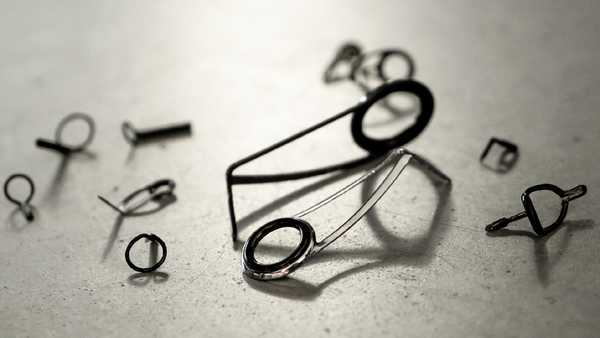
On a rod, the guide is the component you choose last, even though it decides your casting distance, the sharpness of your feedback and how long your line survives. Two pieces make it up: the ceramic the line runs on, and the metal frame that holds it. You choose them separately, and you can get either one wrong.
Fazlite, Alconite, SiC, Torzite on the fishing rod guide ceramic side; stainless, titanium, carbon on the frame side. This guide compares what can be measured, hardness, weight, thermal conductivity and salt resistance, then tells you which combination goes with which style of fishing. If your problem is a guide that is already broken rather than a build decision, our guide replacement tutorial covers it step by step.
A guide does more than hold the line along the blank. It guides the line, spreads the load of the fight across the structure, controls friction on the cast and sheds the heat produced when line runs out under drag pressure. That last role is the one most often forgotten: on a fast run, the temperature at the contact point climbs very quickly, and it is the line that pays.
These functions do not fall to the same part. The ceramic manages glide, friction and heat; the frame manages stiffness, load transfer and salt resistance. One more parameter is often forgotten: the further a guide sits from the reel seat, the more its mass weighs on the blank's action and damps its resonance. A gram saved at the tip is worth several grams saved at the butt.
Japanese manufacturer Fuji offers a full range of ceramics that you need to place in relation to each other before choosing. In order of progression:
- Concept O and Hardloy: the historic aluminium oxide ceramics. Reliable and affordable, they are no longer stocked at Rodhouse, replaced by Fazlite on the same segments.
- Fazlite: introduced by Fuji in 2017, positioned between Concept O and Alconite. Braid friendly, good impact resistance, available on Corrosion Control frames.
- Alconite: the next step up, around 80 % more compressive strength than standard aluminium oxide, at a lower weight.
- SiC, silicon carbide: the technical benchmark for more than twenty years, and the best thermal conductivity in the range.
- Torzite: the most recent, designed specifically for rod guides, the thinnest and the lightest.
You will also come across SiN, silicon nitride, extremely hard and reserved for very specific uses such as heavy rods or wire line, and zirconium, inseparable from the carbon frames discussed below. For the vast majority of builds, the choice comes down to the four ceramics in the middle of this list.
| Ceramic | Hardness (Vickers) | Thermal conductivity | Weight and profile | Main benefit |
|---|---|---|---|---|
| Fazlite Entry level |
Higher than aluminium oxide | Adequate | Close to Alconite, thick profile | The best way into braid |
| Alconite Mid range |
1300 to 1500 HV | Around 11 W/m·K | The heaviest of the four, thick profile | All round versatility |
| SiC High end |
2200 to 2500 HV | Around 60 W/m·K | Intermediate weight, thinner than Alconite | Heat management |
| Torzite Very high end |
Above 2200 HV | Around 27 W/m·K | The lightest and the thinnest | Weight and inner diameter |
These figures are orders of magnitude taken from manufacturer data and independent testing. They vary between sources and measurement methods, and mainly serve to position the materials relative to one another.
Fazlite is the most recent ceramic in the affordable segment. Fuji introduced it to fill the space between Concept O and Alconite, with a simple brief: take braid without flinching, and remain available across the whole K-Series range, from KT to KL-H.
It behaves like an Alconite one notch down on polish refinement, with two advantages of its own. It takes knocks well, which counts on a shore rod that bangs against rocks or a gunwale. And it only exists on the CC Silver White and BC Dark Grey anti-corrosion finishes, designed for saltwater. On a surfcasting rod that lives outdoors, that detail counts more than half a point of hardness.
Who is it for? A first self-built rod, a loaner rod, a shore rod you want to be tough, or any braid build where outright performance is not the goal.
Alconite is a ceramic developed by Fuji from a substantially improved aluminium oxide base: around 80 % more compressive strength, at a lower weight, and a diamond polish that gives a smoother finish than the historic ceramics.
Its hardness, in the region of 1300 to 1500 HV, deserves context. Silica sand, the main abrasive agent in real conditions, sits around 1000 to 1100 HV: Alconite is therefore harder than what is supposed to scratch it. The persistent idea that braid destroys Alconite guides is a legacy of the 1980s, when guides were chrome or mild steel, softer than sand.
Who is it for? It is the default ceramic for a versatile freshwater guide train, and a sound choice inshore as long as the demands stay reasonable. It remains the heaviest and least conductive of the four, which rules it out on very light rods and on fishing with long runs.
Silicon carbide was the reference material for twenty years, and it remains so across a large share of applications. Its hardness, in the region of 2200 to 2500 HV, allows a very fine polish and remarkable wear resistance over time.
Its strength lies elsewhere. Its thermal conductivity, around 60 W/m·K, is by far the best of any guide ceramic. When a fish takes line under a tight drag, heat concentrates at the contact point between line and ceramic. A guide that sheds it quickly protects the line instead of cooking it. That plays out on powerful fish, on long casting distances and on heavy braid use.
Who is it for? Regular, demanding use. An angler who fishes every week, fishes braid and meets fish capable of pulling line will find SiC the best technical compromise in the range. It is also the most widely available ceramic, offered on almost every series and every finish.
Torzite is Fuji's most recent ceramic, designed from the outset for a single use: the rod guide. Rather than settling for a new material, Fuji rethought the geometry of the guide to exploit its properties. Four gaps can be measured against SiC:
- Weight: around 40 % lighter than an SiC of equivalent size. On a titanium frame, the saving on the complete guide reaches around 10 %, and because it allows you to drop a size, mass and inertia at the tip can fall by 20 to 30 %.
- Inner diameter: at equal size, around 15 % larger than an SiC. A Torzite offers roughly the clearance of the next size up in other ceramics, which changes everything for the leader knot.
- Friction: its rounded section doubles the contact length with the line and therefore halves the pressure applied. Fuji quotes friction in the region of one fifth that of SiC.
- Abrasion: in a sawing abrasion test, an SiC lasted 764 passes where Torzite took more than 3100.
One caveat remains. Its thermal conductivity, around 27 W/m·K, is below that of SiC. Torzite compensates through geometry, longer contact and reduced pressure, but when raw thermal load is the absolute priority, SiC keeps the theoretical edge. Being thinner, it is also more sensitive to violent impacts, and it only exists on titanium frames.
Who is it for? Finesse fishing where sensitivity comes first, light rods whose resonance you want to preserve, and builds where you are after the best ratio between inner diameter and bulk. It is also the only ceramic that goes down to size 5 in the KW series.
Everyone talks about ceramic, rarely about the frame. Yet it is the frame that decides durability, the real weight of the guide train and the stiffness of the whole. Three families share the market.
Stainless steel
Stainless steel is strong, forgiving and available everywhere. Its most underrated advantage is its flexibility: it can be bent back after a slight twist, where titanium and carbon snap. Watch the grade, though. 304 stainless is fine in freshwater but corrodes quickly in salt, whereas 316 stainless, known as marine grade thanks to its molybdenum content, resists chlorides far better. Fuji adds CC and BC anti-corrosion treatments that clearly extend the life of stainless frames at sea.
Titanium
Titanium is completely immune to corrosion, and that is its decisive argument. It is also noticeably lighter than 316 stainless at equal geometry, which lightens the guide train and frees up the blank's resonance. It therefore goes hand in hand with high end ceramics: SiC mounts on it readily, Torzite exclusively. A titanium frame can also be anodised to take on colour, without adding material.
Carbon
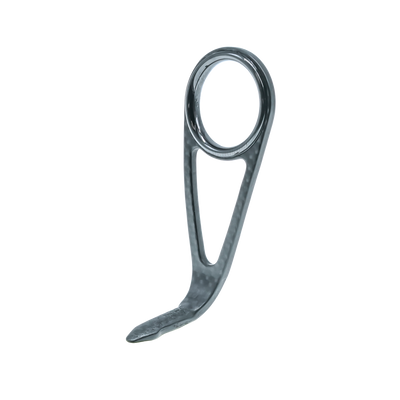
Long restricted to Daiwa's AGS guides, the carbon frame is now available to rod builders. Atlas Carbon guides pair an angle-folded 1K carbon fibre frame with a zirconium insert whose raised outer lip protects the frame and maximises the bonding surface. Carbon is lighter and stiffer than titanium, which further improves vibration transfer. The trade-off: it tolerates mechanical impact less well.
Hence a hybrid setup that works well in practice: carbon on the reduction cone, where the weight saving is felt most and the visual effect is strongest, and titanium in the running guides, to keep a margin of tolerance on the most loaded part of a fine blank.
Corrosion is the number one enemy of guides in salt, and it is a frame issue, not a ceramic one: ceramics are inert. For orders of magnitude, in salt spray testing untreated 304 stainless can show rust in 24 to 48 hours, 316 stainless lasts several hundred hours, and titanium and carbon are simply unassailable.
- Freshwater: standard stainless is enough, corrosion is not an issue.
- Inshore and occasional saltwater trips: 316 stainless or anti-corrosion treated stainless, CC or BC type.
- Heavy saltwater use and zero maintenance: titanium or carbon, the only genuinely salt-proof options.
One last point, purely cosmetic: surface corrosion shows far less on matt finishes. The Gunsmoke and Frosted coatings were developed for that reason as much as for stealth, and Fuji rates them as equivalent in quality. On a stainless frame used at sea, a matt finish will spare you cosmetic rust spots after two seasons. For genuinely heavy saltwater use, Sea Guide guides are an alternative designed for that environment. Whatever the material, it is still a freshwater rinse after every trip that extends the life of your guides the most.
This is the most common question in the shop: series and ceramic are two independent choices, but not every combination exists. The series defines the frame shape and its place in the guide train, the ceramic defines the insert material. Here is what is actually available.
| Series | Frame type | Role in the guide train | Sizes | Available ceramics |
|---|---|---|---|---|
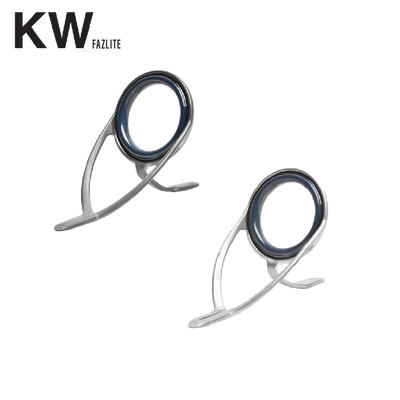
| KW | Double foot, K-Series double slope | Stripper and reduction train | 5.5 to 50 | Fazlite, Alconite, SiC, Torzite |
| KT | Single foot | Running guides, upper section | 3.5 to 10 | Fazlite, Alconite, SiC, Torzite |
| KL-H | Tall single foot | Spinning reducer | 8H to 25H | Fazlite, Alconite, SiC, Torzite |
| KB | Low single foot | Upper section and tip | 4 to 6 | Fazlite, Alconite, SiC, Torzite |
| MN | Classic double foot | Traditional trains, carp, feeder | 8 to 40 | Alconite, SiC |
| LC | Angled single foot | Light and specific trains | 5 to 20 | Aluminium oxide, SiC |
Two practical takeaways. First, the K series, the only ones carrying the anti-tangle double slope designed for braid, are also the only ones covering all four ceramics: if you are still undecided on the material, staying in this family keeps every door open. Second, the KW series covers an entire guide train on its own, from 5.5 to 50, letting you build a complete rod without changing frame family.
The KR Concept, often mentioned, is not a series but a spacing method: it describes how to follow a double foot stripper with a single foot reduction train to bring the line back towards the blank axis quickly. It is therefore built using the series above, not instead of them.
Where do you fish?
This is the frame question, and the most decisive one. Freshwater: stainless, without hesitation. Occasional inshore: 316 stainless or anti-corrosion treated. Regular saltwater: titanium or carbon, the extra cost pays for itself by avoiding a rebuild. A high end ceramic on a 304 stainless frame used inshore is a bad calculation.
What line, what fish?
This is the ceramic question. Monofilament and fluorocarbon in moderate use: Fazlite is enough. Braid in regular use: Alconite holds up perfectly. Heavy braid use, fish that tear off line, long casting distances: SiC for its heat dissipation.
What rod?
This is the weight question. On a powerful rod, the difference in mass between ceramics becomes negligible next to mechanical loads: favour toughness. On a fine spinning rod or a rod whose resonance you want to preserve, every gram at the tip counts, and Torzite on a titanium frame makes full sense. Casting builds follow the same logic, with a shorter reduction train.
None of these answers is absolute, and most successful guide trains are deliberate compromises: a hard ceramic on the first guides, where thermal load concentrates, and a lighter ceramic on the upper section, where weight penalises the action. If you are unsure which combination suits your blank, our team will confirm it with you before you order.





Comments
0Log in to leave a comment.
Log in