


On some days, especially when the sun is shining brightly or fishing pressure is high, the fish are sometimes visible but refuse to bite. They hang motionless, suspended between two depths, indifferent to everything you show them.
This is exactly where mid-strolling comes into its own. This technique, developed in Japan, consists of presenting a soft lure very slowly and in a controlled way in the mid water column, precisely at the depth where the suspended fish are holding. To do this, you impart a light but controlled rolling motion to the lure, imitating a wounded baitfish in its death throes. This article walks you through the mechanics, the gear needed to fish it effectively, and the features of the blank that make it possible.
Whether on a black bass spot, on the edge of a drop-off for zander, or even in an estuary for finicky sea bass, the key is always the same: present the right lure, at the right depth, to an educated fish that has seen it all. To succeed, the lure must move at mid-depth on a dedicated jig head while you give small twitches of the rod tip on a nearly slack line. It is the absolute discretion of this presentation, combined with the rolling motion, that triggers the strike from the most apathetic predators.
Mid-strolling belongs to the broad strolling family, an approach created to specifically target suspended fish. Although it shares the base combo with the Damiki Rig (a minnow-type soft lure on a jig head), it differs radically in its action. To find your way around, here is how the different variants compare:
- Hover Strolling: The most hovering, finesse-oriented version. The lure is rigged without a jig head, but with a single hook and a small nail sinker inserted into the nose. You keep it high in the water column with micro-vibrations.
- Mid-strolling: A horizontal cast-and-retrieve approach through the mid water column. You use a slightly heavier jig head, often with a keeper barb on the shank to keep the lure straight, and a continuous rod-tip action to create the famous rolling.
- Bottom strolling: The same linear, rolling action, but worked right next to the bottom.
Mid-strolling shines when fish are isolated and wary, or when fishing pressure has made classic approaches ineffective. This technique works wonders in clear water, especially when predators are keyed in on schools of fry. It is often associated with cold water and transition periods (autumn or winter), but it proves deadly in the middle of summer, when fish seek refuge in cooler water layers.
In the field, it is a big-water technique: lakes, reservoirs or deep bodies of water. It is mainly used above drop-offs, around bait schools, or out in open water with no obvious structure. Although this technique was initially developed for black bass, it has become widely popular:
- In freshwater: black bass, zander and perch, often suspended above flats or along rocky drop-offs.
- At sea and in estuaries: sea bass, especially when it follows schools of fry between two depths or lies in ambush under structure in slow currents.
Since mid-strolling is a pure finesse technique, all the gear must be chosen to be discreet, sensitive and precise:
- Blank: A Light to Medium-Light power model, with an ideal length of 6'7" to 7'2". This slightly greater length makes it easy to control the line and to pull off animations at a distance.
- Reel: A light spinning model, size 2000 to 2500, well balanced with the rod to avoid fatigue during continuous animation.
- Line: Either a fine braid (PE 0.6 to PE 0.8) with a long fluorocarbon leader (at least 2 m), or a full fluorocarbon line of 6 to 8 lb to maximise stealth and help the lure sink.
- Jig head: Light, generally between 1.8 and 5 grams, with a keeper barb and an eye often bent to 90° to accentuate the rolling motion.
- Soft lures: Slim profiles such as the XPRAT FISH by Sakura, the Nays SPLT or a Slick Finesse by Fox Rage will be perfect.
On the water, success depends on perfect synchronisation between a slow retrieve and the management of slack in the line. The basic move is to cast beyond the target zone, let the lure sink to the right depth, then bring it back at a constant speed. The whole secret is to give small, regular twitches to the rod tip by striking directly into the slack line. This makes the lure roll on its axis, bringing it to life, without rushing it or moving it forward too fast.
Slack in the line is not a problem, it is a tool. When you keep a slight "belly" between the rod tip and the lure, your micro-impulses make the lure pivot on itself instead of pulling it forward or making it dive. If you tighten the line too much, you curb this natural motion and completely lose the hovering effect. It is precisely this control of the slack that brings the lure to life and triggers the aggression of the followers.
Such a precise technique calls for a purpose-built tool. The MS 674-1 X-Ray Pro Stroll blank from North Fork Composites, the brand of the legendary Gary Loomis, was specially developed for this exercise. Its unique hybrid architecture is perfectly suited to imparting continuous micro-tremors without stiffening the line:
- A Zentron fibreglass tip (tinted red): It offers the mechanical softness needed to shake the line without parasitic tension. This ultra-flexible tip lets the fish engulf the lure without feeling any hard point at the moment of the bite.
- A body and butt in X-Ray carbon: They ensure maximum resonance thanks to the high-modulus carbon characteristic of the brand. Despite the soft tip and the slack in the line, tactile feedback remains exceptional. It also keeps a solid power reserve for an effective hookset and for handling good fish.
Its specifications place it straight at the heart of finesse fishing: it measures 6'7'' (200 cm) for just 47 grams on the scale. Its casting range is between 1/8 and 1/4 oz (about 3.5 to 7 g) for a line rating of 6 to 12 lb. Thanks to its characteristic X-Fast action, it offers the smoothness and precision needed for the animation without resisting the fish's intake. All this, while keeping an excellent power reserve.
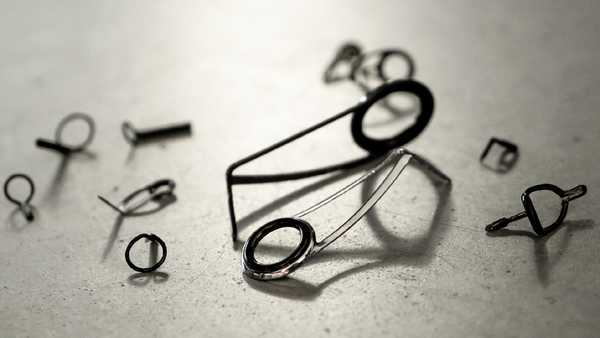
Like any blank, it will reach its full potential in a specialised build, paired with a light guide train and an ergonomic handle to obtain an ideally balanced rod. And if you are looking for more specific tools for harder fishing for sea bass offshore or for sea breams, feel free to look at our ranges of blanks dedicated to saltwater predators.
To sum up, mid-strolling rests on an idea that is simple to understand but demanding to execute: making a soft lure move through the mid water column, right at the level of the suspended fish, by balancing slowness, micro-vibrations and slack control. To get started without getting lost, keep it simple: one or two slim lure models and two jig-head weights are enough to refine your choices over your outings. If you want to create the perfect tool to feel these unique sensations, come and explore our selection of dedicated blanks.


Comments
0Log in to leave a comment.
Log in