


On the coasts of the Aegean, the drop-offs fall away a few metres from the shore and the water stays clear enough to read your spots by eye from the rocks. The fish feed from first light to dusk. Rare ground for a shore angler, then, with one very practical question when you pack: which rod do you take, knowing you cannot bring everything.
Three techniques dominate shore fishing in Greece, and they do not call for the same tool. Ratings, lengths and rigs differ every time, and the real decision comes down to a single do-it-all rod against a specialised set. If you build your own rods, the saltwater predator blanks cover all of these uses.
One piece of information still circulates widely on forums: recreational fishing in Greece is supposedly completely free since the paper licence was scrapped in 2014. That held true for about a decade. It no longer does.
Since 10 January 2026, a European regulation requires recreational sea anglers to register and to report their catches of certain sensitive species through the RecFishing app. Greece has also created a register of recreational anglers, free to join until 31 December 2026. The framework is moving quickly, so check where it stands in the weeks before you travel rather than trusting a dated article.
Three things have not changed on the ground:
- Commercial basins and ferry quays are patrolled by the port police (Limenarchio), who frequently ban fishing there. Outer breakwaters and natural coastline raise no such problem.
- Nets are reserved for professionals. Recreational anglers stick to rod and line.
- Minimum landing sizes apply, so a measure in your bag saves trouble if you are checked.
This is the most widely practised technique on Greek coasts, and the one that forgives poor tackle choices least. Rockfishing means working crevices with 4 to 7 cm soft plastics on 1 to 5 g jig heads, targeting bream, saddled bream, comber, scorpionfish and gobies that live pinned to the rock.
The difficulty is detection. Bites are barely perceptible changes in tension, and a blank with too much backbone erases them completely. What actually works:
- Rating of 0.5 to 7 g, length 2.10 to 2.30 m.
- A solid carbon tip, which loads under a 2 g jig head and betrays the slightest touch.
- Reel in size 1000 to 2000, PE 0.3 to 0.6 braid and a fluorocarbon leader of 0.12 to 0.20 mm depending on how abrasive the spot is.
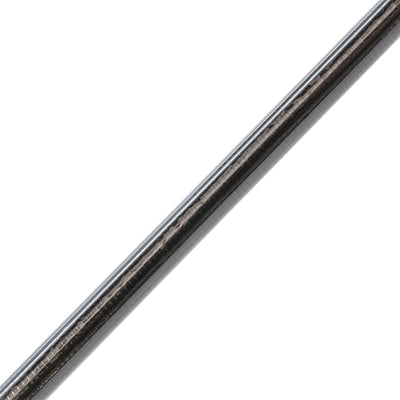
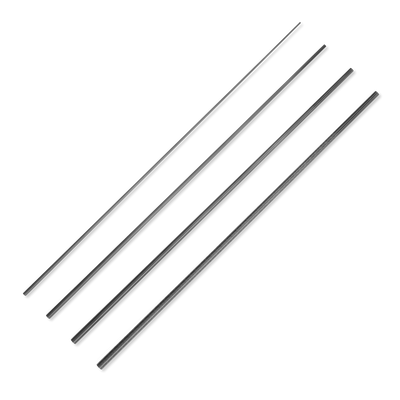
The TR 69 blank is a good illustration of that brief: 2.06 m for a 0.3 to 3.5 g range, with a solid tip that stays readable even when you are working into the wind from an overhang.
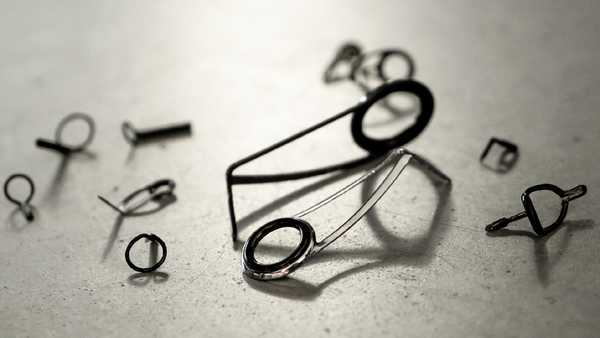
On rock and in salt, marine stainless or titanium guide frames last considerably longer, and the guide packs save you working out the spacing yourself. For a custom build, start from the range of blanks for rock species.
Eging is popular in Greece, but expectations are often poorly calibrated. In July and August, surface water frequently passes 25 degrees and the good squid stay deep. You will mostly meet small squid, a few cuttlefish and octopus. The real season for decent shore-caught squid runs from October to March.
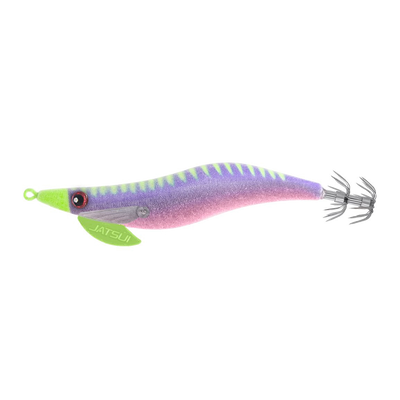
The tackle differs sharply from rockfishing, because the retrieve resembles nothing else: two or three sharp upward jerks, then a long pause during which the egi glides and sinks. The take almost always comes on that drop, and registers as weight settling on the line rather than as a strike.
- Rod of 2.40 to 2.70 m, EGI 2.5 to 3.5, fast or extra-fast action to carry the jerk through to the egi.
- Reel in size 2500 to 3000, with a high retrieve ratio to pick up slack between animations.
- PE 0.6 to 0.8 braid and a 2 to 2.5 m fluorocarbon leader in 0.26 to 0.30 mm, essential against abrasion.
- Egi in size 2.5 for calm water, 3.0 as an all-rounder, 3.5 as soon as there is current or depth.
A head torch and a UV lamp to charge glow egi change a great deal after dark. On the rod side, the squid blanks gather the references suited to this very particular action.
Aegean geology makes this technique formidable: the seabed falls away fast, and you reach 15 or 20 m of water from a rock you can walk to. Where a light soft plastic becomes unmanageable as soon as there is wind or current, a 20 to 40 g jig drops straight and stays under control.
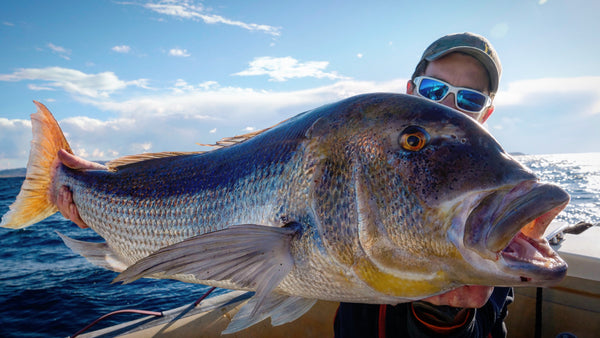
Light shore jigging targets fish on the move: bonito, bluefish, barracuda, leerfish, small amberjack, sometimes a dentex. They pass through, you have a few minutes to intercept them, which is why casting distance matters.
- Rod of 2.70 to 3.00 m rated 15 to 50 g or 20 to 60 g, fast action.
- Reel in size 3000 to 4000 with a smooth, dependable drag.
- PE 1.0 to 1.5 braid and a fluorocarbon leader in 0.30 to 0.40 mm: on a rocky drop-off you need to turn the fish before it reaches the stone.
This style calls for the longest rod of the three, and it is often the one sacrificed for lack of space. If you want to cover it without adding rods, look at the amberjack blanks, whose ratings overlap heavily with light shore jigging.
The temptation is to look for the rod that does everything. It does not really exist here, because the gap between a 2 g jig head and a 40 g jig is too wide for one blank. What remains is choosing your compromise for the trip.
You are taking one rod
Take a 2.10 to 2.20 m rated 5 to 15 g. It covers general shore fishing, casting and retrieving into shoals of mackerel and scad, light eging and very light jigging. It will be too stiff for real 1 to 3 g rockfishing, which is the price of the compromise. In a multi-piece version it fits into compact luggage.
You are taking two rods
Add the dedicated ultra-light. This pairing is the most effective of the three: the ultra-light for rock species at dawn and dusk, the all-rounder for everything else. It also has the advantage of fitting into a single rod tube.
You are taking three rods
The third is the LSJ rod, 2.70 m at minimum. It earns its place if you already know you will fish drop-offs, or if you travel by car. For anyone who would rather have a ready-to-fish setup, the built saltwater rods cover all three profiles.
In Greece, what limits your catches has more to do with stealth than with the fish itself. The water is clear, bream see everything, and a session often hinges on a leader diameter or on how early you get up. Scout your spots during the day with polarised glasses from the overhangs, then come back at first light. Tidal range being close to nil in the Aegean, watching the water replaces reading the tides.





Comments
0Log in to leave a comment.
Log in