


The Bréhat archipelago is a particularly demanding venue for sea bass fishing: strong currents, a big tidal range, fast drifts and fish able to use the slightest structure to their advantage. For this Trophy organised by Fish à l'affiche, two of our Pro-Staffs, Martin Vigot and Julien Le Dez, approached the competition with different strategies.
One was discovering the area for the very first time with his younger brother; the other was returning to water he had already fished from a kayak, for his first boat competition with his teammate. Two experiences, two readings of the venue, and two great results.
For Martin, the Bréhat Trophy was a first. Entered with his younger brother Maël, 16, with whom he had already fished the Glénan Open 2022, he discovered the archipelago on the competition weekend and had never fished the area before.
Fortunately, a few conversations with friends quickly gave them the main trends of the area: mostly soft-lure fishing, well-defined current seams and logical corridors where the bass pass through. “As is often the case in competition, your network matters!”
The strategy was then quickly set: focus on a small sector, repeat drift after drift and come back to the same spots at different stages of the tide. For Martin, there's no point trying to cover the whole archipelago when you are discovering an area so dependent on water movement.
The duo mainly targeted sandy channels where the current rushes between the rocky islets, in 0 to 10 metres of water. With a tidal coefficient of 100 and more than 10 metres of tidal range, drifts could reach 2.5 to 3 knots: precise boat positioning and casting become decisive.
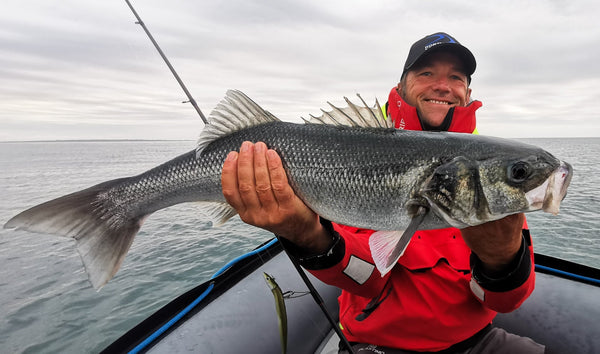
They worked one current seam after another, returning to some of them at different stages of the tide. On Saturday, their bag averaging 46 cm put them in the Top 5. On Sunday, they repeated the same approach, refined with what they had learned the day before: a bag averaging 45 cm finally earned them 4th place overall, a particularly satisfying result given that the venue was completely new to them.
Fish in less than 1.5 m of water
One detail stands out from their weekend: the biggest fish were all caught in less than 1.5 m of water, on the falling tide. An observation that echoes what many shore anglers already notice: the biggest bass sometimes seem to be the last to leave certain spots as the water level drops. At Bréhat, Martin found that this logic also holds true from a boat.
A rod quiver designed to never waste time
As at every competition, Martin and Maël took a large number of combos on board so they could switch quickly from one technique to another. The idea is simple: rather than changing lures when the situation changes, you change rods. On a drift where the first part is fished by hopping the lure along the bottom before switching to a minnow, for example, no re-rigging is needed.
The quiver notably included the Statement 722, Statement 725 and Statement 766, the PPS 72M and PPS 80H-2 blanks, the NFC MB 805HM and MB 807HM, an SJ 803HM and a Phenix K2 712L.
But in the end it was the soft lure that made the difference. The shoals of small sand eels in the archipelago quickly steered choices towards slender imitations: Fiiish's Crazy family, in 100 and 120 sizes, took centre stage.
- In size 100, the Crazy Paddle Tail and Crazy Sand Eel were used both hopped along the bottom and with a gentle lift-and-drop, while the Sand Eel was also fished on a free fall.
- The Statement 722 and Phenix K2 712L were used heavily, paired with 2500-size reels, Prodigy X8 braid in PE 0.8 and 0.23 mm fluorocarbon.
- For the 120 Crazy, Martin used the NFC SJ 803HM for gentle lift-and-drop, notably because its length helps limit the line bow caught in the current.
- For bottom-hopping, the PPS 72M took over, this time with 0.26 mm fluorocarbon.
“With 60+ fish in the Bréhat currents, it gets wild!”
For Julien, the approach was different. The Friday morning departure set the tone: before even reaching Bréhat, he had to pick up friends broken down in the Monts d'Arrée and tow their boat to Paimpol. Once there, it was time for pre-fishing.
The goal was not to catch lots of fish, but to gather information on an area he barely knew from a boat. Julien had already fished Bréhat from a kayak, but the fishing changes radically once on board: the currents move the boat very quickly and force you to adapt your drift lines and casting distances.
“If the boat doesn't pass exactly where you want, you need to be able to cast far.”
The day was therefore devoted to scouting: finding fish, identifying active spots, and above all saving GPS marks to come back to them during the competition. For Julien, this approach doesn't necessarily pay off the very next day: “If you do it regularly, it adds up to a lot of hours on the water, so you build up information that will eventually make the difference.”
This pre-fishing also let him get in sync with his teammate, Jean-Yves Martin, with whom he was fishing his first competition. The fish seemed to be present in the archipelago and sand eel-type lures were already working, but follows on the surface remained rare. The choice for the next day was quickly made: Crazy Paddle Tail.
Day 1: waiting for the current to build
The start was given at 9:30 am. While the most powerful boats quickly pulled ahead, Julien and Jean-Yves stayed calm: their strategy was already set and they knew exactly where they wanted to start, on an area outside the archipelago identified as a passage zone.
The first casts were fairly slow; the tide was still high and the currents were not really running yet. Then, around 11 am, a 47 cm fish confirmed their reading of the spot. For almost an hour, the action picked up and their bag gradually filled.
As low slack water approached, however, the bites became more subtle. Julien slightly downsized his lures and still managed to land a few fish on the CPT 100. The first day ended with a bag averaging 44 cm: not enough to aim for the top places, but enough to stay in the race. The duo finished the day in 11th place.
Day 2: two fish that changed everything
For the second round, Julien and Jean-Yves kept their strategy while deciding to head a little further into the archipelago early in the day, as long as the water level allowed. The start was given at 10:30 am and, this time, the fish responded immediately.
Still on the Crazy Paddle Tail, they simply matched the colour to the water: Ghost Minnow when the water was clearer, khaki when it became more coloured. The choice paid off, and the bag was filled before noon.
A rock caught their attention, and the drift naturally carried them onto it. Jean-Yves cast and got an instant bite. The fish ran with the current, heading dangerously for the rock: he had to clamp down hard. After a few particularly tense moments, the fish slid into the landing net: 57 cm.
The drift continued. Julien aimed for the slack water behind the same rock, a little far, but his rod could reach it. The CPT hit the water, sank steadily, and the bite came: 51 cm. Two fish over 50 cm in a competition with narrow margins: the duo knew they had just pulled off a great move.
The action eventually slowed as low slack water approached. A new spot then proved particularly interesting: a light current seam running along a rocky shore with a small drop-off, a slick betraying surface activity and plenty of sand eels. Julien switched to a CPT 100 and the fish came in: around ten bass were caught, several of which improved their bag.
At the end of the round, their scoring fish measured 57, 51, 46, 46 and 44 cm, an average of 48.8 cm.
The result: 3rd place
At 6 pm, the round was over. The result was still uncertain, but the duo knew they had had a great day. Then the rankings came out: 3rd place. After a 5th and then a 4th place in previous editions from a kayak, Julien made the podium from a boat this time.
“It will be hard to do better next year, but we believe in it. That's what drives us!”
Beyond the sporting result, the Bréhat Trophy also put gear through its paces. Powerful currents, rocks everywhere, fast drifts and a big tidal range: the archipelago does not forgive approximations.
Julien mainly used rods built on the Statement 722 and Statement 724 blanks, two rods that helped him answer three major challenges during the competition.
- Casting distance: when the current speeds up the drift, the boat can quickly leave the productive zone. Being able to cast far lets you keep reaching the strike zone without immediately repositioning the boat.
- Sensitivity: the current sometimes makes bites particularly hard to detect. The resonance of the Statement blanks makes it easier to feel these subtle contacts and react quickly.
- Power reserve: essential when fish use the current and rocks to their advantage. Even a medium-sized fish can become very hard to control in these conditions, and sometimes you have to clamp down hard.
Two ways of approaching the Bréhat Trophy, two teams, two different experiences of the archipelago. Martin and Maël chose to narrow down their fishing area and trust a strategy built around the tides and repeated drifts. Julien and Jean-Yves built their competition around scouting work started on the Friday, before relying on an identified area and a few adjustments over the two rounds.
In both cases, the conclusion is the same: at Bréhat, understanding the current and presenting your lure in the right place at the right time makes all the difference. And when you need to cast far, detect bites in several knots of current and control a bass that knows every rock in the area, your gear obviously has to keep up.
To prepare your own trips, also check out our tips for fishing sea bass with lures in September in South Brittany.






Comments
0Log in to leave a comment.
Log in