


British bass anglers book their leave for September, rarely for July. The water is at its warmest of the year, bait is still holding along the coast, and the fish have spent the whole summer feeding. They are at their heaviest, just before they disperse offshore for the winter.
Bass lure fishing in the UK turns on that combination of factors, and on a way of reading the tide that differs markedly from French habits. Two things remain to sort out before you go: the British regulations, which moved in 2026, and the setup to build. If you build your own rods, the saltwater predator blanks cover all three configurations described below.
Four conditions come together in September, and never all at once for the rest of the year.
- Water temperature peaks for the year, lagging several weeks behind the air. Bass stay active all day and still hunt on the surface.
- Shoals of sandeel, sprat and mullet fry are at their densest close in. Finding one shoal can be enough to make the session.
- The fish have put on weight since spring. September catches average heavier than June ones.
- The days are shortening, which brings dawn and dusk back into slots that fit around a working day. In July, first light comes before 5am.
Add to that the beaches, which empty out after the British school term starts in early September. Marks that are unfishable in August become available again.
British bass rules are renegotiated every year, and they changed for 2026. Plenty of pages still online show out-of-date figures.
- The bag limit has risen to three fish per angler per day, from 1 April to 31 December and in January.
- From 1 February to 31 March, bass fishing is strictly catch and release, by rod or handline only. September therefore sits fully within the retention window.
- The minimum size is 42 cm. Anything below that must be returned immediately.
- No bass may be taken by fixed or drift net. These rules apply identically from the shore and from a boat.
- Some bass nursery areas carry additional restrictions, sometimes seasonal. They vary by district, so check with the local IFCA before fishing an unfamiliar stretch.
Check where the framework stands on the UK government website before you travel. The bag limit is the element most likely to change from one year to the next.
On most British coasts bass come on the flood, but that general rule is of little use on its own. The right window sits at the intersection of the state of tide and the time of day.
Three patterns come up again and again:
- On rock platforms and reefs, the last two hours of the flood and the first of the ebb concentrate fish along the kelp edges. This is the most reliable window there is.
- On the surf beaches of the west coast, a flood tide with a moderate onshore wind creates the coloured, aerated water bass hunt in a few metres from your feet. Sea state then matters more than the tide.
- In estuaries, the ebb flushes shrimp and fry towards the deeper channels. Bass take station there and wait, which makes the fishing very localised.
On spring tides, favour marks with strong flow and headlands. On neaps, go back to shallow reefs and clear water, where a discreet approach comes into its own.
One rod does not properly cover the three types of ground described above. The gap in demand between a calm estuary and an exposed rock platform is simply too wide.
Open coast, reefs and beaches
This is the reference setup across the Channel: 2.70 to 2.90 m rated 10 to 40 g. The length serves as much for casting distance as for holding the line above the rock during the retrieve. The TR 96 Super Seabass, at 2.90 m for 8 to 28 g, falls into this category.
Estuaries and tight marks
Here accuracy matters more than distance. A rod of 2.10 to 2.20 m rated 5 to 25 g lets you place a lure under a bank at fifteen metres, which a 2.90 m will never do cleanly. The Statement 724 fills that role with an action that stays readable on light lures.
Big lures and rough ground
For larger surface lures, sustained current and marks where you have to turn a fish fast, you need reserve. A 2.50 to 2.60 m rated 15 to 50 g like the PPS 86 H-2 absorbs that kind of load.
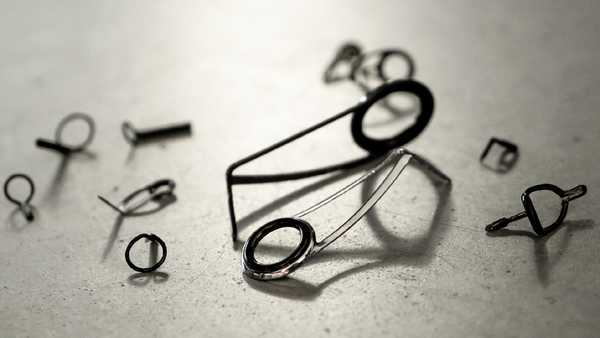
Across all three builds the rest of the setup varies little: reel in size 3000 to 4000, PE 1.0 to 1.2 braid and a fluorocarbon leader in 0.30 to 0.35 mm. On guides, salt and abrasion call for marine stainless or titanium frames, and the guide packs save you working out the spacing. Other options sit in the range of blanks for bass.
In September, bass are locked onto specific prey. Your lures need to match what they are eating right then, more so than earlier in the season.
- A surface lure, walk the dog or popper, for the first hour of daylight and the last of the evening. September is when it produces most.
- A shallow minnow of 100 to 140 mm with a slim profile, to imitate sandeel and sprat.
- A weightless soft plastic, essential over shallow reefs and in the clear water of neap tides.
- A metal of 20 to 30 g to cover distance when the wind gets up or the bait sits further out.
The models suited to these situations sit in the bass lures.
One last piece of advice that holds all month: do not move marks too quickly. In September bass travel with the bait, and a stretch that has been empty for forty minutes can fill in five. Better to cover one tide window properly on a known mark than to half-fish three. For anyone who would rather set off with a ready-to-fish outfit, the built bass rods cover all three profiles.





Comments
0Log in to leave a comment.
Log in