


Black bass are caught with a limited number of moves, but each one answers a precise situation. A fish glued under a branch is not fished the way a fish hunting in open water is, and the lure that works in July in a lily pad mat is close to useless in March on a lethargic fish.
Here are the six techniques that cover most of a season. Each one pairs a family of lures with a fishing situation, because that is how you choose at the water's edge: you read the spot, then you reach for the matching box. You will find every model mentioned here in our lures for black bass.
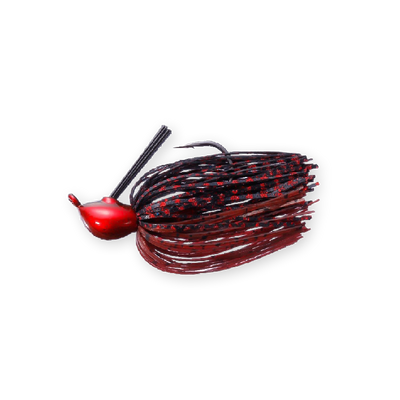
The jig is the most versatile technique on this list, and probably the most underused in France. It is often reduced to slow fishing in contact with the bottom, when it also works as pitching and flipping to place the lure at short range under an obstacle, and as a swim jig retrieved straight above the vegetation.
Its main strength remains access to fish holed up in the hard stuff: under a fallen tree, against a dock, in a pile of branches. There, everything comes down to the weedguard, and that is the development focus of the Zero One Jig. OSP dropped the classic round hole in favour of an oblong one, with the fibres set horizontally and their number calibrated for each weight. The gap between guard and hook point therefore stays small, which stops a branch from slipping in from the side on the drop as well as on the fall, and the guard does not need to be lengthened, which preserves the hookset. That is the compromise every cover jig is looking for.
The line tie, for its part, sits above the head's centre of gravity: the jig rights itself at the moment of the hookset even when lying in the fish's mouth, and it holds a horizontal posture when it stays hung on an obstacle. The worm keeper is barbed so as to hold the trailer without tearing it, which counts when you string together hard skips. The size takes a 4 inch trailer, which makes it a natural support for the craw in the next section.
Fishing it slow, you drop the lure at the foot of the cover, you let the line go slack so the fall stays natural, then you lift the jig ten or fifteen centimetres before letting it drop again. A good share of the bites happens during that fall, usually felt as a weight settling into the line rather than as a knock. On a swim jig, the attack is clean and happens mid-retrieve.
Weight is chosen on the density of the cover as much as on depth. A 7 g sinks slowly and suits shallow margins, an 11 g works through vegetation better and keeps contact when there is wind or current. A soft trailer on the hook adds volume and slows the fall.
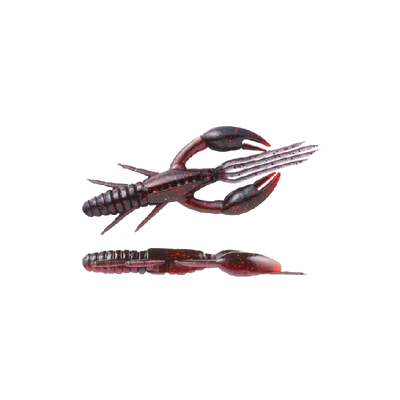
The crayfish is a bottom prey that bass eat all year round. A soft lure imitating one, rigged Texas style, goes anywhere and can be fished at whatever speed you like: it is the easiest rig to reach for when you do not yet know where the fish are.
On the DoLive Craw, OSP built every appendage to work independently of the body. The claws, which the brand calls Swing Hands, catch water during the fall and during the retrieve, and keep swinging even when the fish are not very active. The sensory tentacles and the four reversed legs vibrate continuously, including when the lure sits still on the bottom: there is therefore a residual action during long pauses. The body was drawn with measured width and thickness, so as to stay snag-free while leaving room to bury the point of a Texas hook.
Three rigs cover most cases:
- the light Texas rig, with a 3 to 5 g bullet weight, to search margins and sparse weed beds;
- the heavy Texas rig or the jika rig, to work through dense cover;
- the trailer on a jig, which takes the previous technique and adds volume to it.
The matching Texas hooks are in our hooks range.
That leaves the question of when to prefer the jig. It is the nature of the obstacle that settles it: more compact and heavier, it works through wood and branches, whereas the craw on a light Texas rig slides better over vegetation and can be fished more slowly in shallow water. On a mixed spot, the craw is the safer choice.
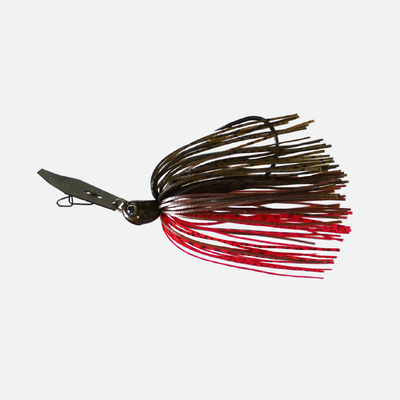
At the opposite end from the jig, the chatterbait is there to eliminate water. Its flat blade vibrates from the first turns of the handle, works through sparse vegetation by deflecting off the stems, and provokes reflex strikes from fish that were already hunting, without you having to slow down.
At Rodhouse, we consider the standard Jack Hammer to be on the large side for many French waters and pressured fish. That is a field position, not a product characteristic. The Baby version answers that observation. The maker states a reduced blade size running at a higher vibration frequency with more subtle flashes of light, the same instant start from the first turn of the handle, and a direct blade to head connection that deflects the lure on contact with vegetation. The compact head and the rearward weight distribution keep a horizontal posture on the retrieve.
The trailer counts as much as the chatterbait model. A slim soft jerkbait such as the Super Fluke, or a stick worm, lengthen the silhouette and suit fast retrieves. A shad or a double grub slow the lure down and make it work higher in the water column. The double wire bait keeper holds everything in place, which saves you resetting it every three casts.
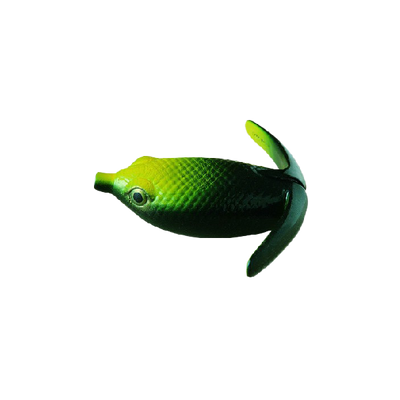
There are spots where no conventional lure gets through: lily pad mats, weed reaching the surface, branches lying on the water. Bass settle there precisely because they are left alone. The frog is built to go and get them, by sliding over the vegetation rather than trying to go through it.
The Basirisky holds a place of its own in this frog family. It is not a concave-mouthed popper but a crawler: on a slow, steady retrieve, its side appendages slap the surface alternately and produce an audible chop that calls fish in from a distance. The soft hollow body floats, with a drain hole at the rear to release the water that eventually gets in. The weight sits on the belly, which balances the lure on the cast and lets you skip it a long way under overhanging branches. The rig comes down to a single heavy-wire Owner hook, hidden in the body with the point facing up, in 4/0 on the 60 size and 6/0 on the 70.
The hookset calls for patience: a bass that explodes under a frog does not always have it in its mouth, and you have to wait until you feel the weight before setting. The rest comes down to tackle, since you then have to pull the fish out of dense cover. Heavy braid, tight drag, and a rod with reserve in the butt. An independent test recommends a medium heavy action for the 60 size and heavy for the 70, which matches what it takes to open a heavy-wire 4/0 or 6/0 single.
Frog or heavy Texas rig? Both fish dense cover, but not at the same height. The frog stays on the surface and suits fish willing to come up, typically in warm water and in the middle of the day on an established mat. The heavy Texas rig goes through the mat to reach the fish underneath, which becomes the right call when surface strikes dry up or when the vegetation is too thick to let the sound through.
There comes a moment in a day when the fish are visible, follow the lures and stop attacking anything. This is the domain of soft lures fished finesse style, with minimal hardware and reduced animation. Two families answer that, and they do not replace one another: the stick worm works on the fall and on movements in place, the soft jerkbait works horizontally by imitating an injured baitfish.
The stick worm, to fish the fall and stay put
The DoLive Stick is built for that. Its lower half carries more salt, which lowers the centre of gravity and steadies the posture during the fall, a detail that counts on wary fish. Three hook settings are laid out in the body: depending on the one you choose, the lure drops vertically or glides at an angle, which is what you need to drift it under a dock or a low branch. It takes weightless, wacky, the Neko rig with a nail weight, drop shot and Texas rigs.
The soft jerkbait, to fish horizontally
The Super Fluke answers a different need. Rigged weightless on a Texas hook, worked with two or three rod tip strokes followed by a pause, it imitates an injured baitfish rolling onto its side. It is the reference model in its category, since copied by most brands. The 5.25 inch size remains the most versatile; the 7 inch version is aimed at fish feeding on larger prey and calls for heavier tackle.
To choose between the two, look at where the fish are. Bass sitting on the bottom or glued to a structure call for the stick worm and its slow fall. Bass suspended in mid-water, or following without committing, call for the soft jerkbait and its horizontal travel.
In early spring and at the end of the season, the water is cold and bass no longer chase. A lure that stays motionless in the water column then becomes one of the few things capable of triggering a strike, because it gives the fish time to make up its mind.
The principle of the suspending jerkbait lies in the alternation. Two or three sharp rod tip strokes to make the lure dart, then a long pause, sometimes five or ten seconds, during which it hangs there without rising or sinking. The bite almost always happens during the stillness.
The Varuna 110 is built around this fishing. OSP states an internal honeycomb structure that thins the body walls and recentres the masses, and flat sides that return more light and push more water than a rounded body. Three sliding tungsten balls move to the tail on the cast to stabilise the lure in flight, then come back forward on the retrieve to produce the side-to-side darting. In fishing terms, what matters most is how it holds the pause: the lure stays flat without rolling onto its side, including after a series of fast rod tip strokes.
It is temperature that decides between finesse and jerkbait, more than the mood of the fish. In cold water, a bass will not chase but will react to a lure that stays in front of it, which gives the suspending jerkbait the edge. As soon as the water warms and the fish start following again, finesse worms take back the lead.
Size follows that of the prey present. A 110 mm suits most freshwater situations in France. A 130 mm size takes over when the fish have keyed on larger prey, at the cost of heavier tackle.
The choice is not made at random: the spot decides. Dense cover and inactive fish call for the jig or the craw, open water and hunting fish call for the chatterbait. A vegetation mat calls for the frog, repeated refusals for finesse, and cold water for the jerkbait.
Tackle follows the same logic, and not only in rod power. The more the spot snags, the harder the whole outfit gets on all three counts at once: braid with no stretch to transmit the hookset at range, tight drag to pull the fish out of the cover before it wraps up in it, a rod with reserve in the butt to open a heavy-wire hook. Conversely, finesse calls for fluorocarbon that cushions, a softly set drag and a sensitive tip, because the fish are in clear water and the hookset is made on a fine-wire hook. A frog and a drop shot therefore do not get fished on the same outfit, and our fishing rods for black bass are sorted by use.






Comments
0Log in to leave a comment.
Log in