


Summer is the season when the rubber jig makes the most sense. As the heat settles in, bass look for easy meals and become more selective. You will often find them nose down along the margins, hunting crayfish and the like.
In this article, you will find out how to choose your jig according to the spot and the conditions, how to work it, and our tackle recommendations, along with our selection of lures for black bass.
Unlike a lure with an active swimming action, the rubber jig works mainly during 2 phases: the fall, and the pause on the bottom. That is why it matters to master the weight and the material of your jig's skirt.
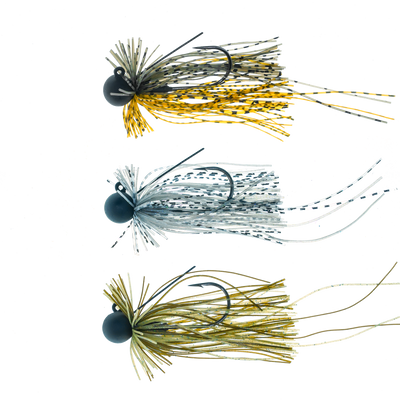
With a silicone skirt model, your jig will behave more sharply because of the stiffness of the material. It will then be more effective in conditions where the fish are active or in clear water. Conversely, rubber models are more effective in cold water or on slower presentations, since the nature of the material means it opens up more slowly and stays fishing at rest for longer.
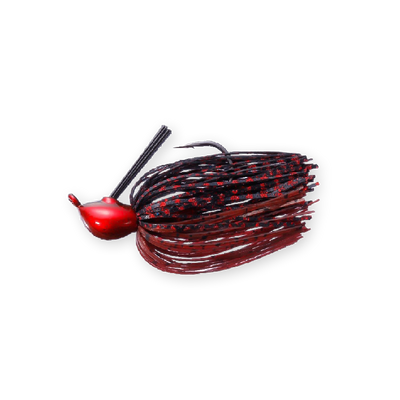
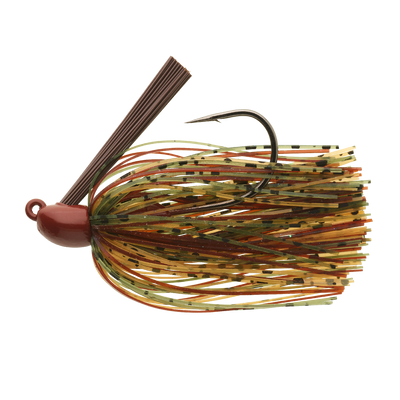
The spot you target will determine the shape of the lead head. A streamlined Arky head (flipping jig) is designed to slip through obstacles and roots. A football head glides more and keeps your presentation upright on the bottom, ideal for rocky bottoms.
Quick tip: early in the season football heads have another advantage, they keep your trailer in a "defensive" attitude, claws up. This behaviour is very common at that time of year because of the moult.
Finally, the last shape, the swim jig, promotes the rolling of your rig, ideal when you want to cover weed bed edges quickly.
You will regularly hear that the 3/8 oz is the do-it-all, which is not wrong but not entirely true either. Although it works very often and gives you a baseline, you should not look only through it. Here is a table that should help you see things more clearly.
| Conditions | Recommended weights |
|---|---|
| Shallow, calm and warm water | 3/16 – 5/16 oz |
| Medium depth, normal conditions | 3/8 oz |
| Deep water, strong current | 1/2 – 3/4 oz |
| Punching, dense cover | 3/4 – 1 oz |
| Cold water | One size below your usual choice |
| Wind | One size above your usual choice |
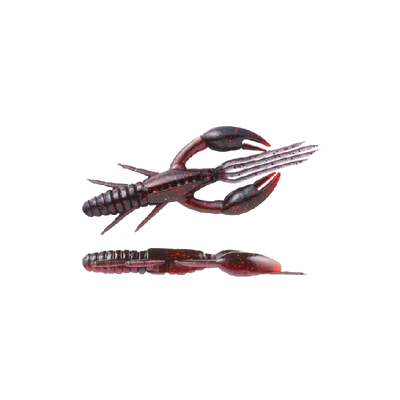
The trailer determines the profile and the fall speed of your rig. A trailer with large appendages (flapping) multiplies the vibrations and tends to slow the fall, whereas a slimmer model has very little effect on its resistance in the water and therefore on its speed.
Flapping models such as the PANTHERA are the ones to favour when the water is stained or when you are fishing dense cover. The slower fall lets you stay longer in the "strike zone" while the vibration of the claws helps the fish locate your lure.
More realistic models such as the CRD from Nays® or the Dolive Craw from O.S.P really come into their own in clear water or on open spots.
Two techniques dominate: flipping and dragging.
Flipping, to present the jig right against cover
This technique consists in presenting the jig as close as possible to cover with short, discreet casts. It lets you cover structures such as weed beds or sheet piling quickly and methodically. Here is how to go about it:
- Underhand cast, quiet entry of the lure, control the fall on a semi-slack line. (watch your braid closely and set the hook on the slightest shift you notice)
- Once on the bottom, hold a pause, two short pulls, another pause
- Reel in quickly, cast again from a different angle on the same spot (5 to 7 casts per spot)
Dragging, to imitate a crayfish on the move
This scraping retrieve reproduces the furtive movement of a crayfish. Very effective in clear water and early in the season in open areas. Here is how to go about it:
- Cast onto the zone, get in contact with the bottom
- Rod parallel to the water, long pull of the rod bringing it towards you, take up the slack line on the reel as you bring the rod back into line.
- Vary your retrieve with small pulls, shakes, pauses.
The stroke jig, to make the jig lift off aggressively
One last technique you will not see much of in France, the stroke jig. It consists in making your jig lift off aggressively with long, sharp pulls. The falling phase here goes with a slight belly in your line. The aim is not to let your jig drop like a stone but rather like a crayfish settling back down after fleeing.
We hope you enjoyed this article and that it helps you get on the board in the tricky moments!
To go further, the jig is only one family among others to keep in the box: have a look at the six lures that cover most of a black bass season, and our fishing rods for black bass sorted by use.
See you soon on Rodhouse







Comments
0Log in to leave a comment.
Log in